

+91 9699915789
Book an Appointment

Wockhardt Hospital
Agripada , Mumbai Centra
+91 9699915789
Book an Appointment
Wockhardt Hospital
Agripada , Mumbai Centra
Our Single Blog Posts
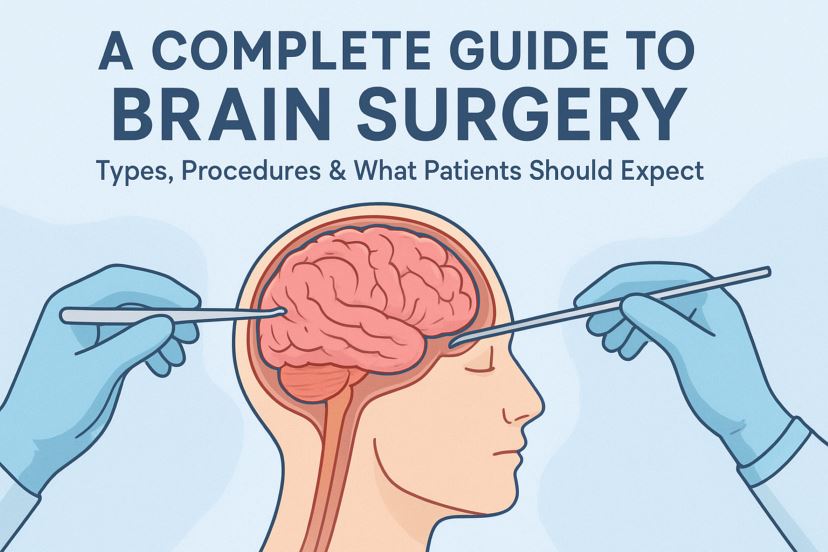
A Complete Guide to Brain Surgery: Types, Procedures & What Patients Should Expect
Posted by admin | Nov 22, 2025
Table of Contents
- Introduction
- Why Brain Surgery May Be Needed
- Common Types of Brain Surgery
3.1 Craniotomy
3.2 Stereotactic (Frame-based or Frameless) Surgery
3.3 Endoscopic Brain Surgery
3.4 Awake Brain Surgery
3.5 Deep Brain Stimulation (DBS) - The Brain Surgery Process: Step by Step
4.1 Pre-operative Evaluation
4.2 Planning & Brain Imaging
4.3 The Surgical Procedure
4.4 Intraoperative Monitoring & Safety
4.5 Post-operative Care & Recovery - Risks and Complications
- What to Expect After Surgery (Recovery)
- Why Choose a Neurosurgeon in Mumbai
- How to Prepare for Brain Surgery
- Conclusion
1.
Introduction
Undergoing brain surgery can feel
daunting. It is one of the most serious medical interventions, but thanks to
advances in neurosurgery, many procedures are safer and more precise than ever
before. If you or a loved one is considering brain surgery in Mumbai,
this guide will walk you through everything: when it's needed, how it's done,
what kinds of surgery are common, and how to recover well.
If you would like to explore local
expertise, Dr Keval Shukla’s brain surgery services in Mumbai offer cutting-edge care with a patient-centred approach.
2.
Why Brain Surgery May Be Needed
Brain surgery is not always the
first option, but there are several conditions where surgical intervention
becomes necessary. These include:
- Brain tumors
(benign or malignant)
- Aneurysms
(abnormal blood vessel bulges)
- Arteriovenous malformations (AVMs)
- Hydrocephalus
(excess cerebrospinal fluid)
- Epilepsy
that does not respond to drugs
- Brain hemorrhage
or bleeding
- Traumatic brain injury with mass effect or skull fractures
- Movement disorders requiring deep brain stimulation
These conditions can impair brain
function, cause seizures, or cause pressure on critical areas — so surgical
approach may bring relief, prevent further damage, or even save lives.
3.
Common Types of Brain Surgery
Neurosurgeons tailor the approach
depending on the condition, location, and patient factors. Here are the most
common types:
3.1
Craniotomy
- The classic “open” brain surgery: a section of the
skull is temporarily removed (craniotomy) to access the brain.
- Used for tumor removal, bleeding, or malformations.
- After surgery, the skull bone is replaced.
3.2
Stereotactic (Frame-based or Frameless) Surgery
- A highly precise, minimally invasive technique.
- Uses a 3D coordinate system to guide instruments deep
into the brain.
- Useful for biopsies, small tumors, or functional
procedures.
3.3
Endoscopic Brain Surgery
- Uses a thin, flexible tube with a camera (endoscope) to
access ventricular regions or lesions.
- Often less invasive, with smaller incisions and faster
recovery.
- Common for hydrocephalus (e.g., ETV: Endoscopic Third
Ventriculostomy).
3.4
Awake Brain Surgery
- The patient remains awake for part of the surgery.
- Used when tumors or lesions are near critical areas
such as speech or motor centers.
- Surgeons can monitor patient’s function in real time by
asking them to speak, move, or name objects.
3.5
Deep Brain Stimulation (DBS)
- Electrodes are implanted into specific brain regions.
- Connected to a pulse generator, similar to a pacemaker.
- Used in movement disorders like Parkinson’s disease,
essential tremor, or dystonia.
4.
The Brain Surgery Process: Step by Step
Here’s what patients generally go
through when preparing for and recovering from brain surgery:
4.1
Pre-operative Evaluation
- Detailed medical history and neurological examination.
- Blood tests, ECG, and possibly cardiology clearance
depending on age and health.
- Consultation with the neurosurgeon to discuss risks,
benefits, and alternatives.
4.2
Planning & Brain Imaging
- MRI (Magnetic Resonance Imaging) and/or
contrast-enhanced CT scans.
- Functional MRI (fMRI) or diffusion tensor imaging (DTI)
if needed to map critical brain areas.
- In some cases, angiography (for aneurysm or vascular
malformations).
- Surgeons and radiologists create a surgical plan based
on imaging.
4.3
The Surgical Procedure
- Patient is admitted to hospital; anesthesia team
prepares for general or local anesthesia (awake surgery scenario).
- The surgical team performs the craniotomy or minimally
invasive access.
- In complex surgeries, neuronavigation (image guidance)
is used for millimeter-level precision.
- If removal is the goal (e.g., tumor), the neurosurgeon
resects the lesion carefully, preserving healthy tissue.
4.4
Intraoperative Monitoring & Safety
- Use of intraoperative neurophysiological monitoring:
helps track brain function (motor, sensory pathways) during surgery.
- In awake surgeries, neurological function is monitored
in real time.
- Constant communication between surgeon, anesthetist,
and monitoring team to reduce risk.
4.5
Post-operative Care & Recovery
- After surgery, the patient is shifted to ICU (Intensive
Care Unit) or high-dependency unit.
- Monitoring of vital signs, intracranial pressure (if
required), and neurological status.
- Pain management, infection prevention, and early
mobilization are prioritized.
5.
Risks and Complications
Every brain surgery carries risks.
While modern techniques make it safer, patients should be aware of possible
complications, such as:
- Infection
(wound or meningitis)
- Bleeding
inside the brain (intracranial hemorrhage)
- Seizures
- Neurological deficits
(weakness, speech problems, sensory loss)
- Brain swelling
(edema)
- CSF leak
(cerebrospinal fluid)
- Persistent headaches or pain
- Anesthesia-related risks, especially in older or medically frail patients
Your neurosurgeon will explain these
risks before surgery and take preventive measures to minimize them.
6.
What to Expect After Surgery (Recovery)
Recovery from brain surgery depends
on many factors — type of surgery, the patient’s age, underlying condition, and
overall health. Here’s a typical recovery roadmap:
- ICU Stay:
24–72 hours of intensive monitoring.
- Hospital Ward:
5–10 days (or longer) to ensure stable neurological function.
- Rehabilitation:
Physiotherapy, occupational therapy, speech therapy (if needed).
- Follow-up Imaging:
MRI or CT scan to check for any residual lesion or post-op changes.
- Medication:
Pain killers, anti-seizure medicines, steroids (if brain swelling) as
needed.
- Long-Term Care:
Lifestyle changes, regular check-ups, sometimes further surgery or
adjuvant therapy (radiation/chemo, in tumor cases).
7.
Why Choose a Neurosurgeon in Mumbai
Selecting an experienced
neurosurgeon and hospital for brain surgery is crucial — especially in a city
like Mumbai, where quality healthcare options abound. Here’s why Mumbai
is a strong choice:
- Highly skilled neurosurgeons: Many neurosurgeons in Mumbai are trained nationally
and internationally, with deep expertise in complex brain procedures.
- Advanced medical infrastructure: Mumbai hospitals often have state-of-the-art imaging,
operation theatres, and postoperative care facilities.
- Multidisciplinary teams: Neurosurgery centers in Mumbai frequently have
neuro-oncology, neuro-rehabilitation, neuro-anesthesia, and
neuro-intensive care specialists.
- Accessibility:
Local expertise means easier logistics, follow-up, and continuity of care.
For expert brain surgery services, Dr
Keval Shukla offers specialized care in Mumbai,
focusing on patient safety, modern techniques, and compassionate recovery.
8.
How to Prepare for Brain Surgery
Here are practical tips to prepare
your mind and body before surgery:
- Educate Yourself:
Understand your diagnosis, surgical options, and recovery. Ask your
neurosurgeon plenty of questions.
- Pre-surgical Tests:
Complete all required blood tests, imaging, and anesthetic evaluations.
- Lifestyle Optimizations: Maintain a healthy diet, manage blood pressure /
diabetes (if any), and stop smoking.
- Support System:
Make sure a family member or caregiver is ready to help you through
hospital stay and recovery.
- Plan for Recovery:
Arrange for physiotherapy, rehabilitation, and follow-up appointments in
advance.
- Mental Preparation:
Brain surgery can be stressful — consider counseling, meditation, or
talking to other patients who have undergone similar procedures.
9.
Conclusion
Brain surgery is a significant,
often life-changing procedure. But thanks to modern neurosurgical advances, it
has become safer, more precise, and more effective than ever. Whether it's a
brain tumor, an aneurysm, or a functional disorder requiring deep brain
stimulation, knowing your options helps you make informed decisions.
If you're looking for expert brain surgery in
Mumbai, Dr Keval Shukla’s clinic offers world-class neurosurgical care,
modern facilities, and a patient-centred approach.
Related Blogs
Table of Contents...
Back pain and spine...

I was recently hon...

Back pain is one of...
Awake brain surgery...
Spinal cord tumors c...
Book an Appointment

Its For your Great Life!
Advanced brain and spine care tailored to your lifestyle and goals.
Fix an AppointmentDr. Keval Shukla is an experienced Brain and Spine surgeon with over 8 years of experience in this field. After completing his training, Dr. Keval has worked at a major corporate hospital in Mumbai .